Sifting Through the Wreckage: Musings on Urban Exploration
In my younger and more delinquent years I found myself fascinated by the prospect of urban exploration. Urbex is the hobby or pastime of exploring man made structures, typically in an urban environment, and typically the buildings are abandoned.
I've always been drawn to the past for inexplicable reasons. The reasons always seem to change depending on the day or my mood, but the core of it has been a desire to understand. I figure one of the best ways to learn about the present and how things got to be the way they are is to try to understand the past.
There are many folks interested in Urbex, and they often have a wide array of reasons for spelunking in these ruins. There are adrenaline junkies and thrill seekers getting kicks from being somewhere they shouldn't be and seeing things they're not supposed to see. The threat of being chastised by property owners and police, and subsequently being charged with trespassing is an ever looming consequence of the pastime. Despite many of these places being abandoned and property owners not exactly caring about the structures or objects that inhabit these places, the land is still theirs. The noble sentiment of "take nothing but pictures, leave nothing but footprints" doesn't negate their right to litigation. Depending on the locale those property owners are able to resort to more forceful methods of protecting their land and assets.
That covers the adrenaline junkies and thrill seekers, but what about the other folks? The colorful cast of people that make up the urbex community come from many walks of life. People interested in the esoteric and forgotten. There are documentarians cataloging ruins through blog posts, photographs, and videos. Appreciators of architecture and delinquent graffiti artists searching for a new and unique canvas. Hoodlums looking for a low-key spot to spark up a freshly packed bowl. And most often, teenagers wandering around just wanting to see "cool stuff."
The community can be as warm as it is secretive. It's often a group or communal activity, as the phrase "safety in numbers" applies when venturing into dangerous or unknown areas. There is a vast ecosystem of cliques and collectives, loosely banded together trading information and secrets on "bandos" like currency. A good group, or even one person in these networks can net you access to untold amounts of hidden locations. Bandos are always an ever changing ecosystem. A bando that was once a low traffic, relaxed excursion can very quickly become a months long headache of court cases if the spot gets blown up. As such, it's a community that thrives on the trust and trade of secrets. I'll show you the way in, but you would do best to keep your mouth shut if you decide to flaunt your souvenir photographs anywhere.
Well, what about the places themselves? Depends on where you live or where you decide to go digging. If you don't have an insider in the community to help you, and you're inexperienced, it can be quite an uphill battle. It can take a keen eye to clock a bando. Urbexing could be an old hospital or asylum, a long deteriorated warehouse, canal tunnels on outskirts, a recently closed Chinese food buffet - or a lonely farmhouse whose inhabitants have passed on, and relatives have never come back to visit.
Each of these places house something captivating. There's a distinct form of melancholy wading through spaces that once meant something to so many different people. It creaks out of old floorboards, joists, and studs. It smells like rotten wood, mold, and soggy insulation. It feels like a sweltering attic of forgotten trinkets and drafty tunnels. If you have a tendency to speculate or dwell on things it tends to make your imagination run wild.
Many abandoned places have been picked clean over the years. Whether things were removed hastily at their decommissioning or picked through by vagrants through time, often there isn't much to see except skeletons. That is, the structural remains of the building. Walls, floors, and if you should be so lucky: a ceiling! Skeletons still provide much of value to the urban fossil record, but sometimes it takes a bit of outside context to piece together the history of a long forgotten place. Even to a layman with no research, they still make great spots to ponder.
The most special of places are those that still have artifacts left behind. Being able to clearly contextualize a place with primary sources is an experience like no other. It's easy to misplace the weight of a decaying building until you're reading records of mental patients from decades ago. Reading the typed words of a doctor trying to find the most academic way to describe a patient screaming their lungs out while smearing their own shit on brick and mortar walls is... unique. It can take a moment to reconcile that the room you just smoked a leisurely cigarette in is the same room someone lost their goddamn mind in.
There are countless moments of reconciliation like this in every abandoned building. Moments of friendship and intimacy, expressions of creativity, vaguely remembered sorrows, and the depths of depravity. Somehow all brought into focus in a singular moment of reflection staring at moldy documents, a half stuffed teddy bear, and peeling paint.
Places with primary sources are tightly kept secrets. One slip of the tongue can ruin an otherworldly preserved slice of time in a matter of weeks. Items get stolen, smashed, and thrown about. Attention which brings the ire of local authorities and property owners. So, if I tell you about this place, you'd do your best to keep this quiet.
It was towards the end of my days in urban exploration, and rarely did I get invited to excursions by the group anymore as my nerves had started to get the better of me each time I'd gone out. The bravado of adolescence was leaving me. I'd just started to worry about things like a college education, and maybe even the prospect of a full time job. The idea of arrests and court cases slowly ate away at me as I heard tales of so and so still waiting to hear the results of their trial. Though I loved each experience, it was only in the afterglow of a successful extraction that I derived pleasure from each outing. I was now only invited to the most low risk spots, because no one wanted to hear me whine or see the anxious look on my face. But my friend knew me, and knew it'd be remiss of me not to come.
It was an unassuming Victorian house on the corner of old Northeast suburbs. The shrubs and trees had overtaken the front and side yards long ago, only the driveway was clear enough to see the back side of the house. Unfortunate for the value of the property, but perfect cover to enter through a front door that'd been kicked open long ago.
The foyer was oddly formal, even for an old Victorian house. There were a few chairs lining the entrance, and diplomas hung up on the wall. Following the hallway to the back, on the left you were greeted with a perfectly preserved 40 year old dental examination room. To the right, a once meticulously kept workshop with and endless amount of drawers, chemicals, and plaster impressions of people's mouths strewn all about the room.
The house had belonged to a dentist. On the first floor he ran his lifelong dental practice, and upstairs was his house proper. Seeing such a well preserved practice from decades ago was exciting enough, but beyond the workshop was the dentist's real pride and joy: his private study.
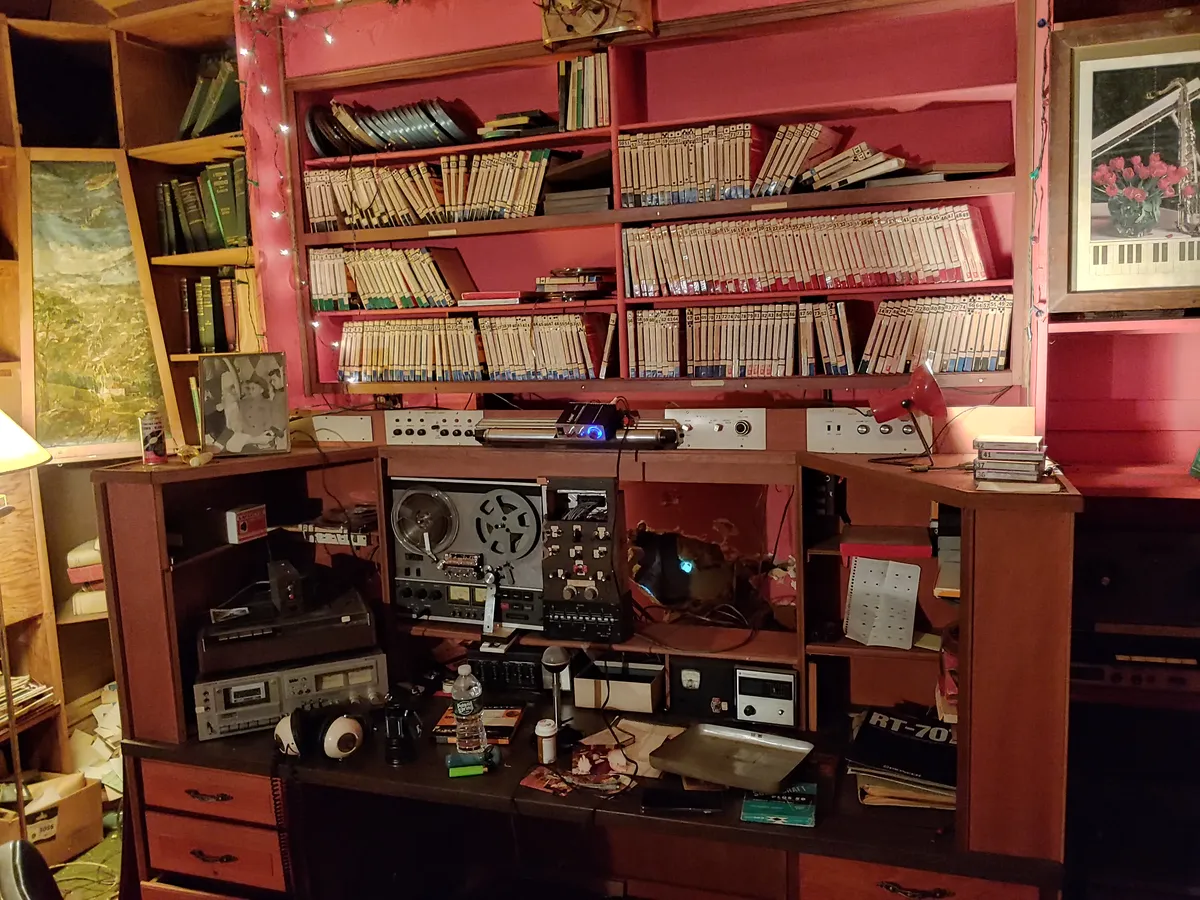
Inside this private study were multiple reel to reel tape decks, speakers lining the walls, and dozens of reel to reel tapes everywhere. The ceiling had even been perfectly vaulted and tuned to the specifications for his hifi set up. On my friend's previous visit here, he managed to fix up one of the tape decks up enough to a working state. Perhaps most miraculously, the power for the house was on. He produced an amplifier from his backpack, hooked up the reel to reel player to the speakers, and we began to listen.
We spent the afternoon listening to old quarter inch tape reels recorded from the 1960s through to the 1980s. Slowly, as we listened, we began to piece together an image of this dentist. Most of the tapes were recorded somewhere between 10 at night to four o'clock in the morning. The dentist was a diagnosed insomniac. He mused about philosophy, classical music, literature, and his dental practice. Rarely did he speak about his personal life.
We found an old photo album and flipped through it as we went through the tapes chronologically. We saw pictures of the dentist from a young age, and slowly through the years watched the bags under his eyes go from mildly amusing to deeply concerning. And his voice in those tapes... Each year the weight seemed to grow heavier. Thoughts less collected, speech a little bit more drawn out.
Sometime through the listening session, my friend found a box with a projector and some home movie reels. As we listened, he set up the projector and tried to get it to work. Somehow he managed to warm up the bulb and unstick the motor. So we sat, listening to this dentist's tapes, looking through his photo albums, and dimmed the lights to watch home movies of faded, color shifted family gatherings from decades ago.
As each year passes the details of this dentist get more hazy. I forget more of the contents of those tapes, and I forget the pictures in those home movies. I once knew his name, but I don't remember it anymore. But for some reason, I'll never forget the sound of his voice.
There are many others that have visited that house after my friend and I. I've seen the pictures that've been circulated and shown off like contraband crown jewels. Yet there are few very few pictures that study, nor any mention of the contents of that study compared to the pictures of his practice.
And I just can't shake that thought. Every once in a while, when I can't sleep, I think about that dentist and his private study.